
By Justin Guay and Vrinda Manglik
Narendra Modi has secured India’s prime minister position with a sweeping mandate.
What that mandate will bring is an open question. Many have serious concerns about Modi’s human rights record in Gujarat, while environmentalists worry about his administration's desire to speed environmental clearances for dirty fossil fuel projects.
How Modi uses his mandate leaves the fate of India's future energy mix precariously perched between 19th century fossil fuels and modern clean energy technology.
What that mandate will bring is an open question. Many have serious concerns about Modi’s human rights record in Gujarat, while environmentalists worry about his administration's desire to speed environmental clearances for dirty fossil fuel projects.
How Modi uses his mandate leaves the fate of India's future energy mix precariously perched between 19th century fossil fuels and modern clean energy technology.
Modi's energy policy is still heavily reliant on dirty fuel sources, with a special emphasis on increasing coal expansion. However, there is a silver lining - he's all in on solar . With a freshly minted pledge to bring solar power to all 400 million Indians living in the dark, Modi has elevated solar to the prime time - and made an important break with the fossil fuel status quo that the international community will do well to watch.
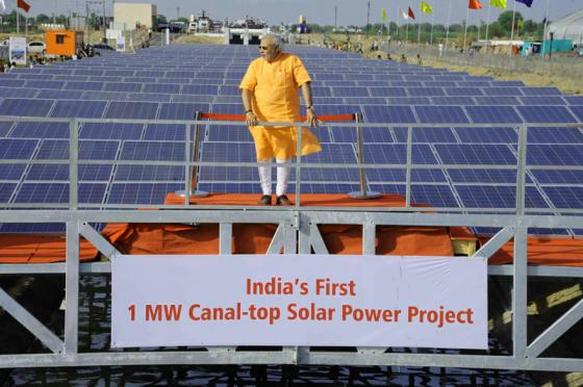
Narendra Modi at the Canal Solar Power Project near Chandrasan village in Mehsana district of Gujarat
However, the first and most important thing to realize about Modi's pledge to bring power for all is that it's nothing new. Prime minister after prime minister have promised complete energy access since India's independence in 1947, and all have failed miserably. That's why there are roughly 80 million households still without power. Yet, Modi's pledge is different in one important way - the type of energy he has chosen for the job.
Rather than relying on ineffective, expensive, and slow centralized grid extension, Modi has chosen the most appropriate power source for this job - distributed solar. Of course, breaking with the past failure of fossil fuels by no means ensures future success. But what Modi is promising is the first of its kind anywhere in the world. So, just how ambitious is this promise, and can Modi really deliver? To answer those questions, we need look no further than neighboring Bangladesh - a hot bed for off-grid solar installations.
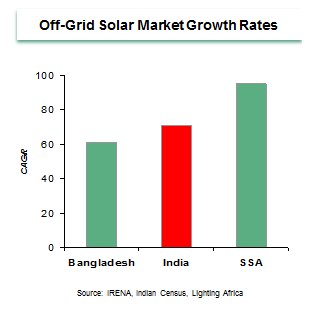
Bangladesh is home to a whopping 2.8 million off-grid solar home systems, and every single month, the country pumps out 80,000 new installations. That's thanks to the wildly successful Infrastructure Development Company Limited (IDCOL) program, a model India would be wise to replicate. IDCOL has led to surging 60.86 percent compound annual growth rates (CAGR) over the past decade, increasing the number of solar home systems installed from 25,000 in 2003 to 2.9 million in 2013. That's a CAGR investors here in the U.S. would drool over.
Let's compare that growth to what Modi needs in order to deliver on his pledge. According to the 2011 Indian census, there were approximately one million households using solar. In order to increase from that small base of one million to total access for 80 million people in five years, Modi needs to increase the solar sector at a 71.07 percent CAGR. While that seems like a steep demand, judging by Bangladesh's success, it is eminently doable. Especially if you compare it to the 95 percent growth rates the World Bank's Lighting Africa program has clocked for sub-Saharan Africa.
Rather than relying on ineffective, expensive, and slow centralized grid extension, Modi has chosen the most appropriate power source for this job - distributed solar. Of course, breaking with the past failure of fossil fuels by no means ensures future success. But what Modi is promising is the first of its kind anywhere in the world. So, just how ambitious is this promise, and can Modi really deliver? To answer those questions, we need look no further than neighboring Bangladesh - a hot bed for off-grid solar installations.
Bangladesh is home to a whopping 2.8 million off-grid solar home systems, and every single month, the country pumps out 80,000 new installations. That's thanks to the wildly successful Infrastructure Development Company Limited (IDCOL) program, a model India would be wise to replicate. IDCOL has led to surging 60.86 percent compound annual growth rates (CAGR) over the past decade, increasing the number of solar home systems installed from 25,000 in 2003 to 2.9 million in 2013. That's a CAGR investors here in the U.S. would drool over.
Let's compare that growth to what Modi needs in order to deliver on his pledge. According to the 2011 Indian census, there were approximately one million households using solar. In order to increase from that small base of one million to total access for 80 million people in five years, Modi needs to increase the solar sector at a 71.07 percent CAGR. While that seems like a steep demand, judging by Bangladesh's success, it is eminently doable. Especially if you compare it to the 95 percent growth rates the World Bank's Lighting Africa program has clocked for sub-Saharan Africa.
In sum, Modi's goal is not only achievable, it's already working in both Bangladesh and Africa. If he is able to stay on track, every Indian household may be seeing a brighter solar future very soon.